Showing posts with label farm. Show all posts

Saturday, September 10, 2011

Farm treasures

If you recall my farm series (May 2011), you may remember reading about my Grandma's garden, her preserves and canned goods, and her sauce spoon (Taste a little of the summer).

I mentioned I would love to have a sauce spoon like hers. It was unique to Grandma's era and you just don't see them used anymore.  Grandma would empty a jar of home-canned peaches (or plums or pears), stored in her fruit cellar, into a glass bowl and serve them with this silver sauce spoon.

A sad occasion, the recent sudden and unexpected death of my Uncle Marvin, brought me back to the farm in White Lake, South Dakota.

Uncle Marvin, a bachelor, bought the farm from my grandparents when they retired and moved into town in the early 1960s. But what was unique is that the farmhouse remained furnished with all of Grandma and Grandpa's furniture, dishes, silverware, utensils, pictures, wall-hangings, doilies, decorative items and linens. My uncle replaced very little and moved nothing from its designated place. So a visit we made there through the years was like a trip back in time. 

All that was missing was Grandma and Grandpa.

After Uncle Marvin's funeral, I stayed for several days to help sort through things, do a little cleaning, and be part of setting a plan in motion for what was left. His Will set forth legal direction for disposal of assets, but not all the furnishings in the house, barns and out-buildings.

These are not just furnishings. They are our treasures from the past. Dividing them among two surviving sisters, a sister-in-law, and nineteen nieces and nephews is a daunting challenge. Though not a materialistic family, these treasures represent the love we feel for our grandparents and we would each like a memento or two, irregardless of its value to anyone else.

Like the sauce spoon, for instance.

When I mentioned this to my aunts, and told them how a simple sauce spoon linked me to my grandmother, the memory creating a warm place in my heart, they presented it to me, saying, "From Grandma with love." 
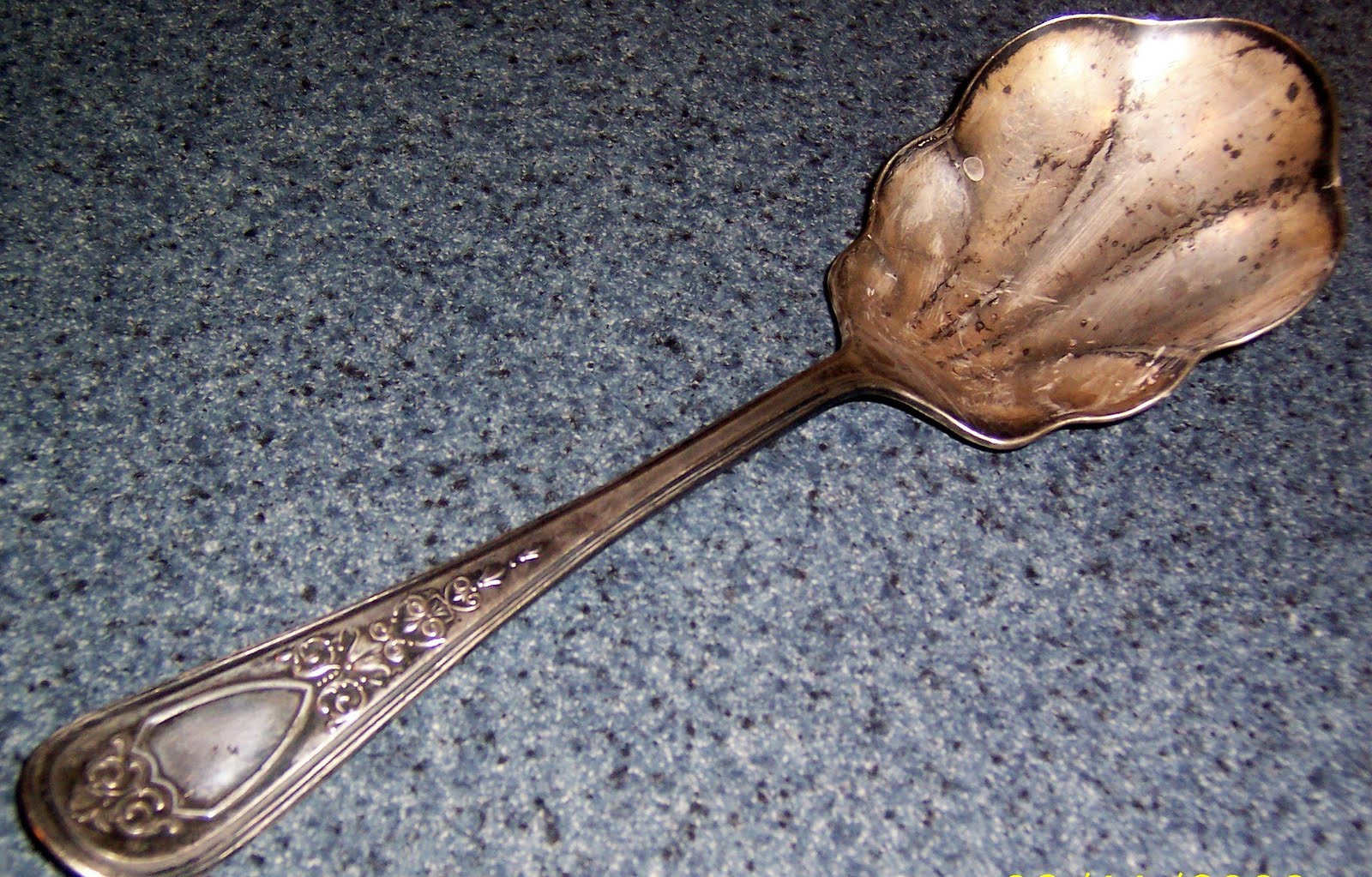

It was found way in the back of an all-purpose utensil drawer with potato mashers, assorted knives, ice cream scoops, meat forks, and pastry cutters all heaped on top of it.  It was dirty, dusty, and black. I am certain, without a single doubt, that my Grandma was the last to use it.

After several attempts with Hagerty silver polish, I decided to seek out a professional silversmith to try to restore it to its former lustre.

So as I stood there creating a scene with my profuse gratitude and tears, my cousin's husband went to the fruit cellar in the basement and produced one of Grandma's fruit jars to complete this wonderful gift. The jar had a zinc cover on it and some very old dirt inside. Although I even treasured the very old dirt, it did get washed.

All of Grandma's canning jars are still in place in the fruit cellar. I liked this one over the old blue Ball jars because of its waffle pattern on the outside.

I am so happy to have these two treasures. They are all I need. My Grandma  resides in my heart, but I will use my jar and sauce spoon to honor her memory.

Thank you, Grandma.

Friday, June 10, 2011

Back to the farm

In 1957, we learned that my Aunt Norma was engaged to be married to a man named Bob Kristensen. She had known him for many years; most of her life, actually. We had never heard of him.

But that wasn't the worst of it.

It meant she would be moving from St. Paul, Minnesota, back to her hometown, the small farming town of White Lake, South Dakota, following her June wedding.

Now this came as a real shock.

Aunt Norma, my Dad's sister, was our very special, beautiful aunt who stayed with us to babysit, bought us things and, in any way possible, spoiled us. She had a bubbly, outgoing personality and an infectious laugh.

She had been dating a handsome man in St., Paul named Don. So, I just naturally assumed if she got married someday, it would be to him.  Don was jovial, fun, a tease, and...well yeah, okay, maybe a bit boisterous. Maybe even more so after a few beers. Okay, sometimes obnoxious.

But who in the world was this Bob Kristensen guy, and why would Norma leave the glamour of her city life to settle down in White Lake? On a farm, no less. It was great fun to visit White Lake every summer as kids, but to live there? All the time? That was another matter altogether.

Aunt Norma worked in a contractor's office, not far from our home in the Macalester-Groveland neighborhood. By this time, I was old enough to venture that far on my bike, so I occasionally rode over that way to stop in to say hello.

Of course, I was reasonably sure I'd also be treated to a ten-cent cherry phosphate at Towey’s corner drugstore on the corner of Selby and Snelling.

To a twelve-year-old, pre-teen girl, Aunt Norma was just the type of young woman to be idolized. She always wore the most beautiful clothes, red nail polish, clip earrings and high heels. And she had a winning smile and that wonderful, charming laugh.

So the whole move-to-White-Lake thing was baffling to me. 

And then we met Bob Kristensen. His quiet, soft-spoken and gentle ways very quickly won us over. So opposite the boyfriend, Don. So less artificial; so very much more real. Our new "Uncle Bob."

June 1957
The wedding was at Trinity Lutheran Church in town. 

Construction had just been completed at the newly-built brick church, but the landscaping had been delayed due to many days of steady, soaking rain.

With no sod having yet been laid, the entire church yard resembled a muddy pig-pen  Not just your mere garden-variety mud, but something more like quicksand. My memory is very vivid in that regard because I got stuck in the mud, and I wasn't the only one. Someone, I don’t know who, had to come pull me out, my shiny black patent shoes caked with the wet, sticky, gritty substance.

It was a beautiful wedding. Following the church basement reception, a party that continued to the wee hours was held in the garage at Grandma and Grandpa’s farm.

Norma and Bob settled on the Kristensen family farm, not far from Grandma and Grandpa's farm. Uncle Bob continued to share farming the land with his twin brother, Ray.

And so my glamorous, Aunt Norma became a farm wife. She took pride in tending her chickens, cooking, baking, and playing the organ at church. She was actually a natural in, what was to her, a familiar environment.

Come to think of it.....she never seemed happier.

Friday, June 3, 2011

Taste a little of the summer

Some years back, Greg Brown wrote and recorded a wonderful, folksy song called, Taste A Little of the Summer.  I really love the lyrics, which go partially like this: 
When I go see Grandma, I gain a lot of weight,
With her dear hands, she gives me plate after plate.
She got magic in her, you know what I mean,
She puts the sun and the rain in with the beans.
She cans the pickles, sweet and dill,
And the songs of the whippoorwill,
And the morning dew and the evening moon,
I really got to go and see her soon.

Cuz the canned foods I buy at the store,
Ain't got the summer in 'em anymore.
You bet Grandma, as sure as you're born,
I'll take some more potatoes and a thunderstorm.


Peaches on the shelf, potatoes in the bin,
Supper's ready, everybody come on in,
Taste a little of the summer.
Grandma put it all in jars.
Grandma had a large vegetable garden on the farm. Though she likely never heard the phrase organic gardening, she used only manure to make her soil rich and fertile.

I'd go out to the garden with her to pick green beans for dinner, listening to the plink-plunk sound of them as they hit the bottom of the aluminum kettle, and then quieting as the kettle was filled to the brim. We'd carry the beans into the kitchen, after cleaning our muddy shoes on the boot scraper kept by the back door.

From Grandma's garden, I learned that potatoes grew under soft mounds in the ground and you had to dig them up. In the city, Mom just bought them at the store.

Grandma preserved all her own fruit, vegetables and pickles in Mason jars. They were stored in the fruit cellar (they said cellar; we said basement), all lined up in an orderly fashion, like treasures, on wooden shelves. Cases of pop were kept in the fruit cellar as well, so you could always open a cool bottle.

She'd open up a jar of peaches at mealtime, put them in a large bowl, and serve them with a “sauce spoon.” A sauce spoon was larger than a tablespoon and more rounded. I would love to have a sauce spoon like Grandma had.

Her dishes were Fiesta ware. Now they’ve made a comeback and you can buy reproductions quite cheaply. Grandma had the economics of this beat, however, as hers were free. Premiums in boxes of detergent.

Grandma made a chicken dinner for fifteen look effortless. Here is her recipe.


The recipe looks pretty simple, I know. 

But, first, Grandma had to find the chicken running in the yard (I think they knew what was coming), catch it, use her little axe to wack off its head, and then before she could prepare it for baking, pluck its feathers and clean it. Until then, the poor hen just ran around in circles with no head.

Grandma made her own bread, kept in a blue speckled canner on the kitchen counter. She made raised doughnuts, and the best homemade butter you can even imagine. Remembering the creamy saltiness of it makes my mouth water.

For the dog, Butchy, she made Johnie-cake out of cornmeal. Cut in large squares, covered with leftover gravy, if there was any, she'd bring it outside where Butchy would be salivating from the aroma coming from the kitchen. The oven was heated by burning corncobs.

I only saw my Grandma cry once.

Uncle Marvin had enlisted in the Marine Corp. and went off to his tour of duty. We were there one summer when he was home on leave. But the time had come for him to return to Camp Pendleton. As he left the farm and drove down the long dusty driveway, Grandma stood by the road watching him go, wiping her tears with her apron.


~ A mother’s love. ~

And she stood again by the road as our summer vacation came to an end and it was time for us to leave the farm. We watched from the back car window and could see her waving until we were down the road, around the corner and well out of sight.

~ A grandmother's love. ~


My grandparents,
Charles and
Christina Steffen
When I look back on those summer days visiting Grandma and Grandpa on the farm, I realize just how rich those experiences were. We couldn't know then the valuable lessons we were learning.

My dear grandparents were the most loving people I've ever known.  Full of faith, character, integrity and conviction.

.... And at night, when the house was very quiet, Grandma could be heard softly reading the day’s devotion from Portals of Prayer to Grandpa before they turned out the light and retired for the night. 


Wednesday, June 1, 2011

Small town rituals

The small, rural town of White Lake, South Dakota, held great fascination for us six kids as we visited there each summer. It was our Mayberry.

Although the farm itself was a novelty, the small town routines of the 1950s were even more interesting to us.

An "ice cream man" came to the farm to deliver Popsicles, ice cream and frozen novelties.  This differed from the ice cream wagons with their tinkling bells that drove slowly up our neighborhood streets in the city. The White Lake ice cream man stocked the deep freeze (we said freezer; they said deep freeze).

Then there was the "bread man" who, similarly, stocked the freezer (deep freeze) with bread and buns. We had a "milk man" in the city, but, of course, there was no need of that on the farm, because another ritual was taking the milk to the White Lake Creamery in town. First, of course, came the twice-daily ritual of milking, skimming the cream from the frothy milk in the stainless steel "separator" and filling milk cans.

The stores were open on Friday nights in White Lake and everyone headed to town, as much for socializing as for weekly shopping at Oltman's dry goods, Gambles, or Ehler's General Store.

We were excited as we cleaned up from our day's play, dressed in something better than our play clothes, and piled in the car for the 8-mile ride to town.

The kids all congregated together by the stores as we'd each been given a nickel for a pack of gum, maybe Black Jack, Beeman's, or Clark’s Teaberry. Or a Baby Ruth candy bar. Or Necco wafers. When we were a little older, we could get a cherry Coke at Warrell's drug store, or the Silver Dollar cafe.

The women did their shopping, while the men played pool or just drank red beer (beer with tomato juice) in the tavern or the Legion Hall. It was a big social night for all, and a weekly ritual for farm families isolated most of the week.

Saturday night was bath night. With one small bathroom and a limited water supply, we had to share the water. Where at home we could fill the bathtub, there was barely enough water to cover us, but we didn't mind.

Trinity Lutheran Church
ca. 1970
Sunday mornings, as at home, were reserved for church.

But church at White Lake was much more fun than it was at home as it meant we could sit together with all the other kids, and not with our parents.

This was a practice they had, and we thought it was great. We wished we could do that at our church at home.

I made friends with a few girls my age. Mary Ann lived down the road from my grandparents' farm, and Kathy lived a few miles away. Grandma would drive me to Mary Ann's, and that was the only occasion, or the furthest, I'd ever seen her drive. 

Kathy's mom would drive over to pick me up for a visit. I thought she was the prettiest mom I ever saw, and always pleasant, always smiling. I thought Kathy was so lucky, as I couldn't imagine her mother ever scolding her. She always offered us nectar (we called it Kool-Aid). 

Over the years, I was able to see how different my White Lake friends' lives were from mine; and yet we were the same, laughing at the same silliness and sharing 'Teen magazines when we were older.

My Grandpa had a quiet sense of humor, always stood with his hands behind his back, and delighted in playing tricks on us. His cow-pie trick became a ritual for us kids, as well as our cousins who visited.

First, he would claim to have a “secret" to tell us, or he'd ask us to come over by him to look at something oh-so-interesting. 

Of course, he’d stand in front of the pile of manure, blocking its view.

When we came close enough to him, he’d take us by the arm and into the “cow pie” we’d step. He'd take no regard of our footwear: barefoot, sandals, or Sunday patent leather shoes. If we were barefoot, he’d laugh about the manure squishing between our toes.

No cow pies in sight? Then it might be chicken poop. My mother didn't always think it was so funny, but we sure did. We fell for his trick every time, even though we usually knew what was coming. Grandpa would laugh like he really got us.

Ah, the simple fun, the simple rituals, the simple life.  I know now how choosing life on a farm is anything but simple.

But to us as kids, it was simply delightful, and a treasure to recall.

Thursday, May 26, 2011

Going to the farm

My grandparents had a wonderful old farm in the small town of White Lake, South Dakota.


And this is where our family of eight spent all of our summer vacations.

The annual trips to the farm were all the vacation my parents could afford. But I wouldn’t have known, or appreciated, anything about that. Or even cared. 

The anticipation of a trip to the farm to see Grandma and Grandpa trumped a Grand Canyon, Black Hills, or even a Disneyland tour, as some of our friends were doing over their summer vacation.

All of us crammed into whatever vehicle Dad drove that year, squished together in the back seat. One of the younger kids would even ride in the window area above the back seat. No seat belts to hinder our climbing around each other and changing places.

Then my Dad started buying Rambler station wagons, and we enjoyed the luxurious space. To pass the time, we would sing songs along the way and stop for picnic lunches in a local park.

Before Interstate 90 was built, our route took us through many small Minnesota towns, like Pipestone, Marshall and Worthington. It was an eight-to-ten hour drive then, depending more on our level of cooperation than the speed of the car.

In our very early years, a pink plastic potty was used for our nature calls, Dad simply stopping the car along the road. Later, because we were older or there were more of us, we stopped at gas stations or, if we were lucky, restaurants.

The Red Rooster CafĂ© was the only place I remember stopping to eat where we had to pay. It had a sign on the wall that intrigued us through the years: 

Seville, der dago,
Tousan buses inaro.
Nojo, demis trux,
Summit cowsin, summit dux.
As we grew older yet, I taught my younger siblings how to sing in rounds. We sang Himmel und Erde, in German. And a Jewish round. And rounds I learned at Camp Fire Girls' camp.  I'm sure it drove our parents crazy, but at least when we were singing, we weren’t arguing and bickering.

We'd pass the Welcome to South Dakota sign; then the sign for White Lake; and finally, the quiet gravel road leading to the farm.

Past the mailbox, up the long driveway, we'd see the farm with its pump for fresh water, a blue speckled tin can hanging on a hook at its side, outside the back kitchen door.

No matter the time of day or night that we arrived, Grandpa and Grandma always met us at the back door and were excited to see us. Six children certainly brought chaos to their otherwise quiet and orderly home. But if they minded the disruption, we never knew it.

The farmhouse always smelled the same: a mixture of yeast from Grandma's baking, fried chicken, Old Spice aftershave, and, if the screen door was open, a hint of manure.

The unique smell of South Dakota air, the expanse of sky with bright stars not seen in the city, the chirping of crickets breaking the silence of night, and the wide open fields, were really wonders that were new, then again familiar, with each visit.

We wouldn't have wanted our summer vacation to be anywhere else.